Haara: A Dance of Life and Death
HAARA Turn the Ancient Dance of Death Into a Psychedelic Celebration of Life on “A Dance of Life and Death”
by Jack Rush
Swiss-based experimental psychedelic collective HAARA invite listeners into a mysterious world where ancient folklore, unconventional instrumentation and modern psychedelia converge on their ambitious sophomore album, A Dance of Life and Death. Released via Rattler Records, the ten-track concept album explores mortality, human resilience and the universal search for a better existence, weaving together musical traditions from different corners of the world into an imaginative and thought-provoking listening experience.
Inspired by the medieval tradition of the Danse Macabre, the album takes an unconventional approach to one of humanity's oldest themes. Traditionally depicting humans and skeletons dancing together as a reminder of death's inevitable triumph, HAARA deliberately turn the concept on its head by introducing the idea of life into the equation. Rather than simply contemplating mortality, the collective explores the tension between life and death, darkness and hope, and the possibility of embracing change and uncertainty.
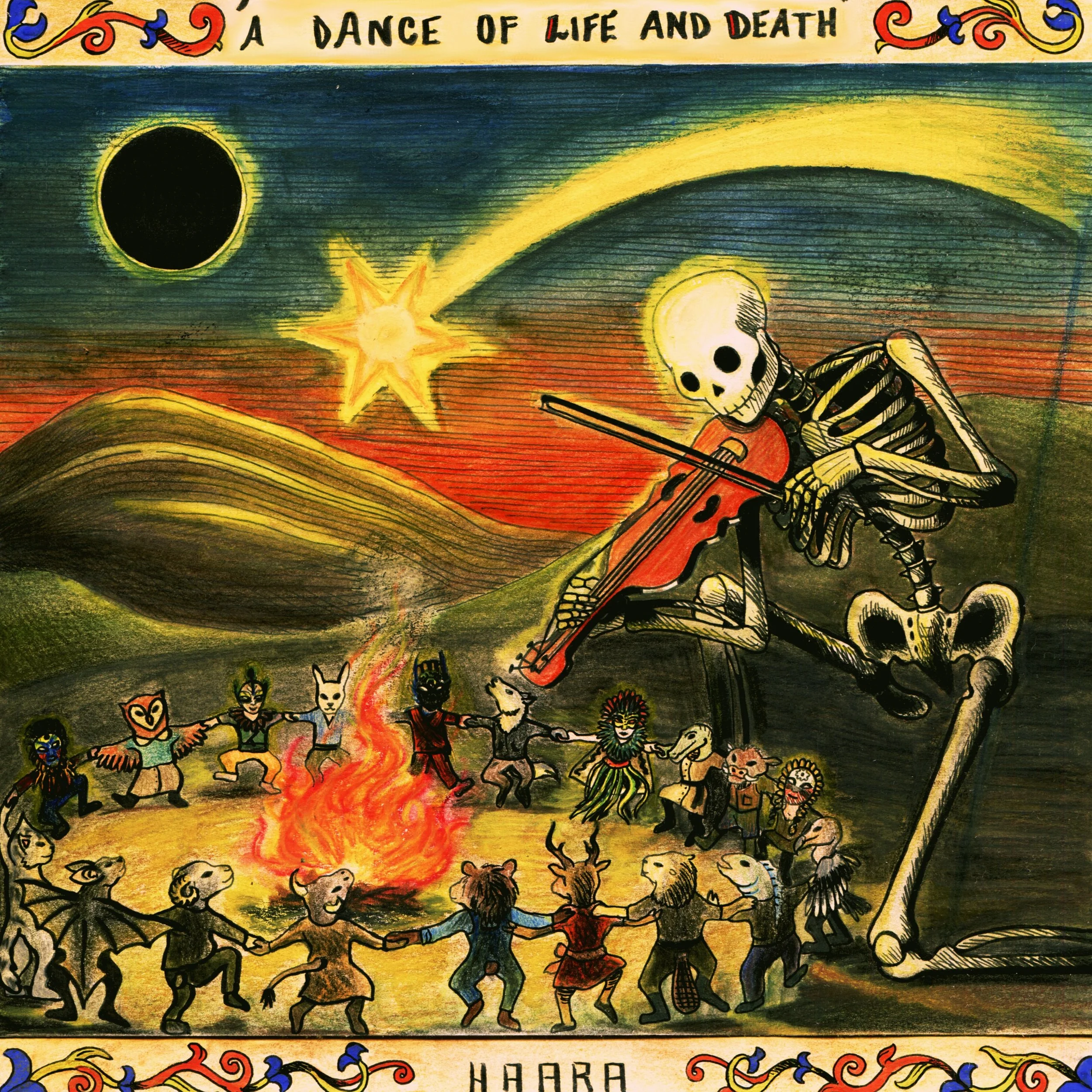
This duality is reflected in the album's striking visual identity, which evokes a medieval fairytale world populated by mysterious symbols. An annular solar eclipse and a comet cross the twilight sky, while a tribal gathering dances around a fire, seemingly unaware of the figure of Death watching from beyond the circle of light. It's an evocative image that captures the album's underlying atmosphere: beautiful, unsettling and rich in symbolism.
Musically, HAARA build their compositions around an ancient technique known as the drone, or bordone, in which a continuously repeated note provides a hypnotic foundation for evolving melodies. Historically rooted in musical traditions stretching across Asia, the Middle East and Europe, this approach becomes a recurring motif throughout the album, symbolising the ever-present shadow of death. Its most striking expression arrives on “Sublime,” where a single double bass note provides the foundation for an atmospheric exploration of sound.
Around this central concept, HAARA construct a fascinating musical landscape drawing on Bulgarian folk singing, sub-Saharan Gnawa traditions and European musical heritage, while embracing the possibilities of contemporary psychedelic experimentation. The instrumentation is equally adventurous, incorporating the Bolivian charango, Australian didgeridoo and traditional ciaramella from Amatrice, alongside an expanded use of flute and transverse flute. The result is a distinctive meeting point between ancient musical traditions and modern sonic exploration.
The album's diversity is particularly evident in tracks such as “Sublime” and “La Sirena,” which reveal different dimensions of the collective's compositional approach. The latter stands out as an engaging suite built around classical guitar and orchestral elements, unfolding like an epic narrative in which the forces of nature interact. Sung in Italian, it offers a different lyrical and musical perspective from the predominantly English-language material. “Sublime,” meanwhile, incorporates expressions of vulgarised Latin, further reinforcing the album's connection to ancient cultural traditions.
Another highlight is the three-part “Deport,” which introduces a darker narrative dealing with displacement and the human pursuit of a better future. It's a subject that adds a contemporary dimension to the album's historical and philosophical themes, reminding us that the struggle between life, death and the desire for freedom is not simply an abstract concept but an ongoing human experience.
The collective's vocal approach also contributes to the album's distinctive character. Drawing on traditional-sounding chants and tribal-inspired choral arrangements, the lyrics often feel closer to ancient storytelling rituals than conventional contemporary songwriting. Guest musicians Matteo Bonfatti, contributing lead guitar to “Dunes,” and Luca Ezio Marsiglia, whose transverse flute features on “La Sirena,” further enrich the album's sonic palette.
The closing title track brings the various elements together in a hypnotic, shoegaze-influenced finale, offering a fitting conclusion to a journey that moves between darkness, beauty and introspection.
What makes A Dance of Life and Death particularly compelling is that HAARA never allow their experimental instincts to overshadow the underlying narrative. There's considerable musical ambition here, but the unconventional arrangements and diverse influences always serve a broader artistic vision. Beneath the medieval imagery and darker philosophical reflections lies an unexpectedly optimistic message about resilience, freedom and the importance of embracing life's unpredictable nature.
With their sophomore album, HAARA have created an imaginative and immersive work that challenges familiar musical boundaries while exploring themes that remain as relevant today as they were centuries ago. A Dance of Life and Death is an invitation to contemplate our mortality, but ultimately, it's a reminder to celebrate the life we have.
Have a listen and connect with Haara: