
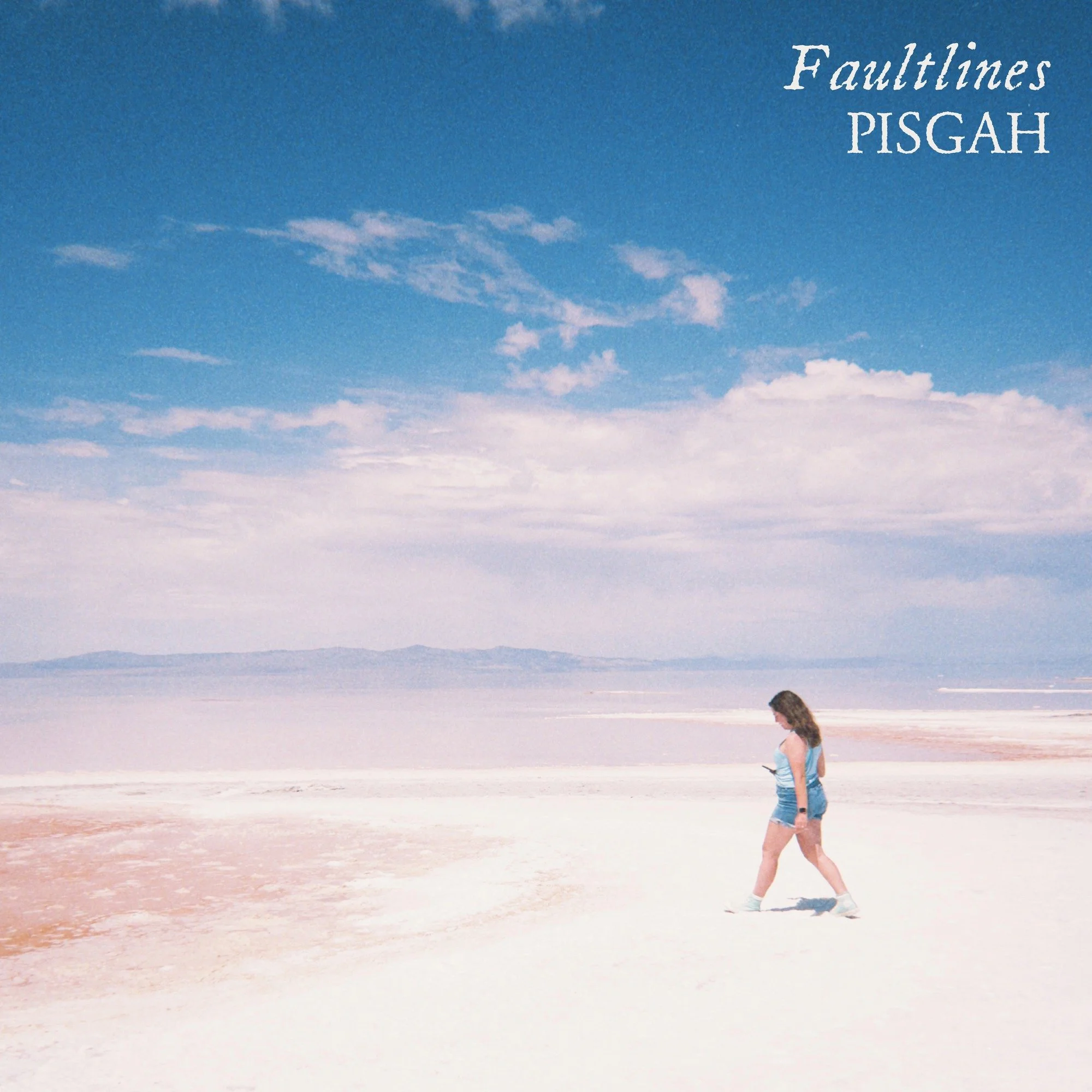
Pisgah: Faultlines
Pisgah Maps Inner Ruptures and Renewal on the Intimate, Expansive ‘Faultlines’
by Jack Rush
With Faultlines, Pisgah — the solo project of London-based American songwriter Brittney Jenkins — delivers a second album that feels less like a continuation and more like an arrival. Following her quietly acclaimed 2022 debut Call Louder for Me When You Call, Jenkins steps forward with a record that refines her sonic identity while deepening her emotional reach, balancing shimmering indie rock with unflinching confession.
Written and recorded in her home studio and shaped in collaboration with producer Dan Duszynski, Faultlines unfolds across eight meticulously crafted tracks that trace emotional fractures with patience and clarity. Drawing on the introspective lyricism of Julia Jacklin and Ex:Re, the raw vulnerability of Big Thief and Indigo de Souza, and the shadowed atmospheres of Emma Ruth Rundle and Chelsea Wolfe, the album inhabits a space that is at once intimate and cinematic, fragile and quietly ferocious.
Jenkins’ songwriting is the album’s true center of gravity. Faultlines examines generational trauma, loss, and the slow recognition of how relationships — with others and with oneself — fracture over time. Rather than lingering in collapse, the record treats rupture as necessary terrain, a painful but illuminating path toward rebuilding. Jenkins herself frames the project as an exploration of where “fault lies when our relationships… break down completely,” a theme that recurs with emotional precision throughout the album.
Musically, the record moves fluidly between euphoric guitar layers and stark minimalism, allowing space for both tension and release. Singles like “Cumulonimbus,” “Favor,” and “Bend to Break” hint at the album’s emotional range, but in sequence the songs reveal a broader narrative arc — one shaped by slow-burning revelation rather than dramatic climax. The production remains restrained yet expansive, preserving the intimacy of Jenkins’ voice while giving the arrangements room to breathe.
Visual and symbolic language plays a central role in Faultlines. Jenkins’ background in art history permeates the album’s world, drawing inspiration from Francesca Woodman, Ana Mendieta, Gregory Crewdson, and William Christenberry. The cover image, photographed near Utah’s Great Salt Lake and influenced by Robert Smithson’s Spiral Jetty, mirrors the album’s themes of entropy, transformation, and the inevitability of change. Even tarot imagery enters the frame, with Jenkins aligning the album’s spirit to The Tower — catastrophe not as end, but as clearing.
Though technically her sophomore release, Faultlines feels like a debut in the truest sense: the moment when voice, vision, and narrative converge. Born in the American South and shaped by a transatlantic life since 2015, Jenkins draws on Americana storytelling, incisive alt-rock, and dreamlike textures to build a sound that is both grounded and exploratory.
Vulnerable, atmospheric, and deeply considered, Faultlines is a record about collapse that never indulges despair. Instead, it documents the quiet courage of rebuilding — a body of work shaped by fracture, rebuilt through clarity, and guided by an artist fully stepping into her voice.
Have a listen and connect with Pisgah: