Old Ma Cuxsom & the Soapchoppers: Don't Cry Darling (Daddy Had to Drown the Cat)
OLD MA CUXSOM & THE SOAPCHOPPERS - A LOST TRANSMISSION FROM AN ALTERNATE 1986
by Jack Rush
There are comeback stories, and then there is Old Ma Cuxsom & the Soapchoppers.
Most bands who disappear for forty years stay disappeared. Their songs remain trapped on rehearsal tapes, forgotten C60 cassettes and the increasingly unreliable memories of people who were there. Old Ma Cuxsom & the Soapchoppers have taken a rather more improbable route: they have returned to finish the debut album they were supposed to make in 1986.
And somehow, The Painted Bridge doesn't feel like a nostalgic exercise.
It feels like a record that has been waiting for its moment.
Formed by Northern schoolboys in the early 1980s, Old Ma Cuxsom occupied an eccentric musical territory somewhere between British psychedelia, garage rock, literate indie-pop and the surreal humour of everyday Northern life. Their songs were written when their members were barely old enough to drive, yet their subject matter ranged from nuclear war and Russian invasion to failed electric cars, Catholic school experiences and the absurdities of local politics.
The band were teenagers, but the world they were observing was already beginning to look strange.
Their timing was remarkable. They emerged just as The Smiths were breaking through, while the musical world that would eventually produce Madchester and Britpop was still taking shape. They played alongside future legends, accumulated NME mentions, built a following across the North-West and eventually found themselves in a BBC Radio 1 session with Andy Kershaw at Yellow 2 Studios — the same legendary facility associated with bands such as New Order and The Smiths.
Then, just as the story seemed to be beginning, it stopped.
Adult life intervened. The members scattered. Careers, marriages, children and geography replaced rehearsal rooms and gigs. Singer Timmy Carpark became a father. Other members became teachers, carers, traders and professionals. The band became one of those great musical what ifs — a footnote in an alternative history of British indie.
Until someone decided to reopen the file.
The result is The Painted Bridge, recorded in 2026, four decades after the songs were originally written and due for release in January 2027. And that time gap is arguably the album's greatest asset.
Rather than attempting to recreate 1986 with forensic accuracy, the project throws the band's teenage compositions into an entirely unexpected environment: the Caribbean, where the reunited musicians recorded with cult American producer Kramer, alongside Soca impresario Cory Carson Raggie.
The collision is wonderfully unlikely.
The Northern English worldview remains at the centre of the songs, but the surroundings have changed completely. The result is a peculiar combination of vintage British psych-pop, analogue grit, warped tropical warmth and dark melodic humour. There is something deliberately out of time about it — as though a forgotten British indie record has somehow washed ashore forty years late and in the wrong hemisphere.
That sense of displacement suits the material.
Because listening to songs written in the early 1980s from the vantage point of 2026 creates an unexpected effect. What might once have sounded like teenage exaggeration can now sound almost prophetic. Nuclear anxiety, political absurdity, technological optimism gone wrong, social dislocation and a growing sense that something isn't quite right with the world are no longer simply subjects for eccentric teenage songwriters.
They are contemporary life.
That makes The Painted Bridge more than an exercise in musical archaeology. It becomes a conversation between two versions of the same band: the teenagers who wrote the songs and the older men who finally got the chance to record them.
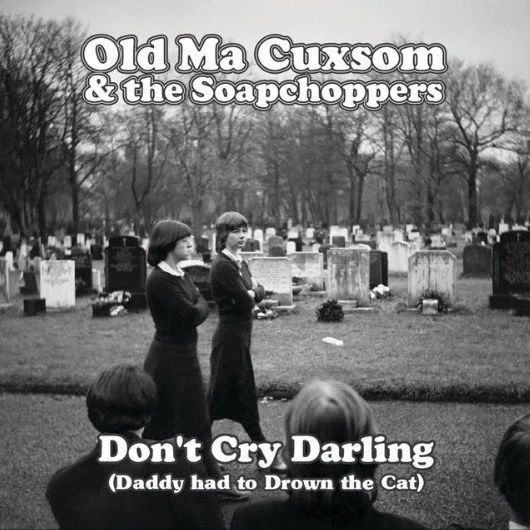
The first single, “Don't Cry Darling (Daddy Had to Drown the Cat)”, perfectly captures the project's peculiar sensibility. Even the title suggests the band's refusal to take the conventional route from A to B. There is darkness here, but also absurdity; tragedy is never allowed to exist without a crooked smile lurking somewhere nearby.
And then there is the visual world surrounding the record.
When the band discovered photographer Stephen Johnson's extraordinary archive of early-1980s black-and-white photographs of St Helens and the surrounding North, they found something they could never have manufactured in 2026: their own lost landscape. These aren't generic retro images chosen to make a modern record look old. They are photographs of the places, streets and world that actually existed around the band when the songs were being written.
That gives The Painted Bridge a remarkable documentary quality. The album isn't simply pretending to be from 1986. In a strange sense, it actually is from 1986 — the songs just had to wait forty years for someone to record them.
Even the circumstances surrounding the reunion seem to belong to the band's mythology. A schoolboy band disappearing into adulthood; members being tracked down across countries; old friends stepping back into abandoned roles; a month in St Lucia; Kramer behind the controls; Thurston Moore somewhere in the vicinity; and an old schoolmate unexpectedly turning up on a cruise ship as a Paul McCartney impersonator and ending up singing backing vocals.
It sounds less like a record-production story than a lost episode of a particularly surreal British comedy.
And perhaps that is ultimately what makes Old Ma Cuxsom & the Soapchoppers so appealing.
They aren't attempting to convince anyone that they are still 16.
They aren't trying to manufacture a fashionable reunion or reconstruct some mythical version of 1980s indie culture. Instead, The Painted Bridge embraces the absurdity of the whole enterprise. These are songs written by teenagers, recorded by men in their later lives, produced in the Caribbean, surrounded by musicians and characters from entirely different musical worlds, and released into a cultural landscape that somehow makes the lyrics feel more relevant than they might have been forty years ago.
That is a difficult trick to pull off.
But perhaps the strangest thing about The Painted Bridge is that the long delay doesn't feel like a handicap.
It feels like the point.
Old Ma Cuxsom & the Soapchoppers aren't making the album they might have made in 1986. They're finally making the album that was always supposed to exist — four decades late, gloriously out of time, and arriving just when the world seems ready for it.
Sometimes a lost record doesn't need to be rediscovered.
Sometimes it just needs to be finished.
Have a listen and connect with Old Ma Cuxsom & the Soapchoppers: